 Wonderful Peace
And Can It Be That I Should Gain
Hear this hymn on the organ or piano in the Wonderful Peace app.
- And can it be that I should gain An interest in the Savior’s blood? Died He for me, who caused His pain? For me, who Him to death pursued? Amazing love! how can it be That Thou, my Lord, shouldst die for me?
- ’Tis mystery all! the Immortal dies! Who can explore His strange design? In vain the firstborn seraph tries To sound the depths of love divine; ’Tis mercy all! let earth adore: Let angel minds inquire no more.
- He left His Father’s throne above, So free, so infinite His grace! Emptied Himself of all but love, And bled for Adam’s helpless race; ’Tis mercy all, immense and free, For, O my God, it found out me!
- Long my imprisoned spirit lay, Fast bound in sin and nature’s night; Thine eye diffused a quickening ray, I woke, the dungeon flamed with light: My chains fell off, my heart was free, I rose, went forth, and followed Thee.
- No condemnation now I dread, Jesus, with all in Him, is mine; Alive in Him, my living Head, And clothed in righteousness divine, Bold I approach the eternal throne, And claim the crown, through Christ, my own.
Words as printed in old hymnals, free for anyone to sing and share. Checked word for word against an old printed hymnal: Methodist Hymnal 1905 #310.
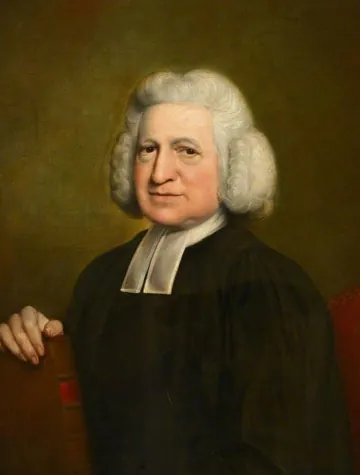
Portrait by John Russell, 1771
The story behind the hymn
In May of 1738, Charles Wesley was a young minister lying ill in London. For years he had tried hard to earn God’s favor, and still felt no peace.
On Whitsunday, the twenty-first of May, he came at last to a quiet trust that Christ had died for him, and that his sins were forgiven. Two days later he wrote in his journal that he had begun a hymn about his conversion, but had stopped, for fear of pride.
Many believe that “And Can It Be” is that hymn, or one written very soon after. Hymn scholars are not certain which of his early hymns he meant. Either way, this one sounds like a man who could hardly believe what had happened to him: “Amazing love, how can it be that Thou, my God, shouldst die for me?”
One verse remembers how the angel freed Peter from prison in the book of Acts. Wesley wrote that his own heart had been like a prisoner in a dark cell, until a light shone in: “My chains fell off, my heart was free, I rose, went forth, and followed Thee.”